How to Keep Non-engineering Teams Informed About Software Releases Without Creating Bottleneck Dependencies


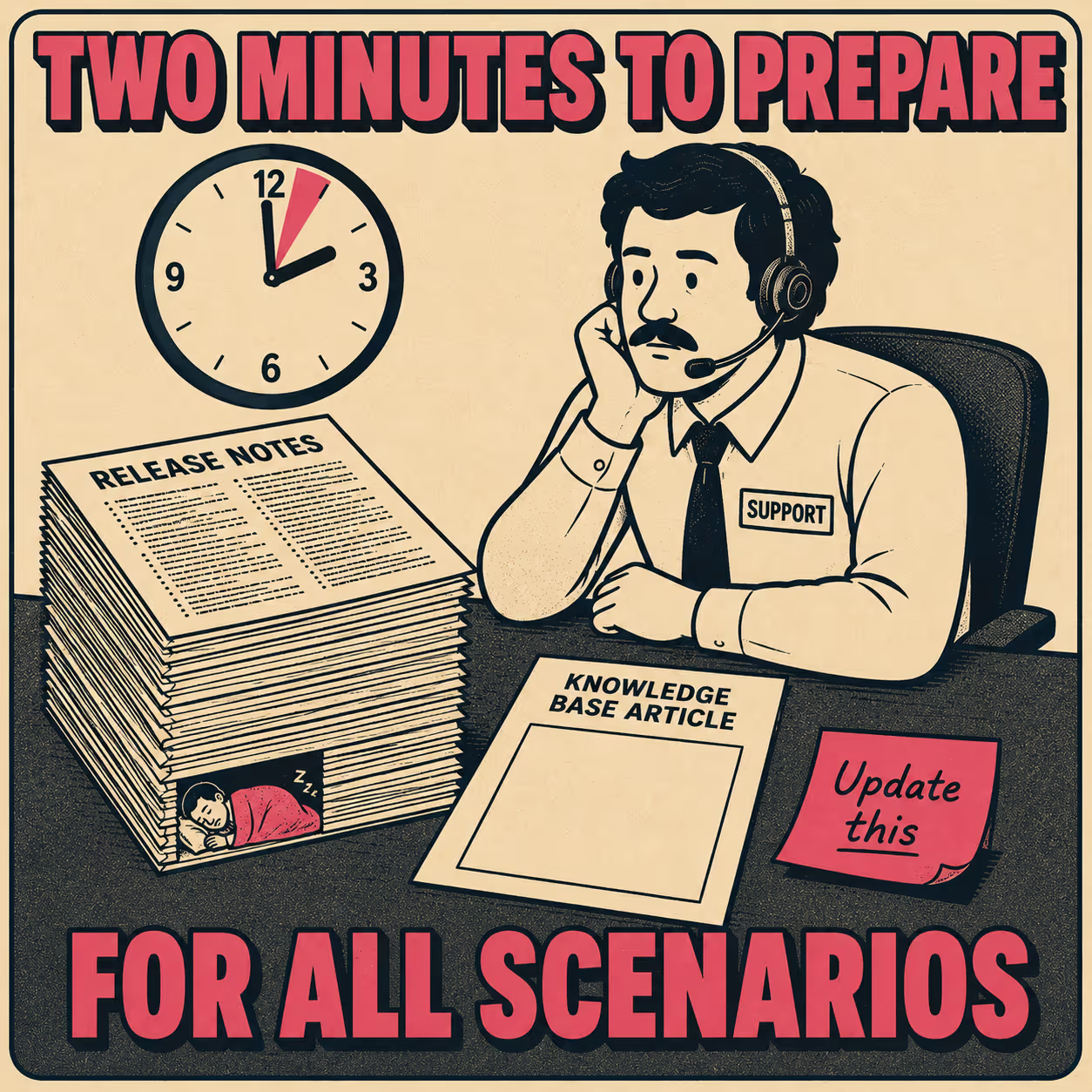
Five minutes before a customer call, a support agent opens the latest release notes. She needs one thing: what changed, and how does it affect the user she's about to talk to. What she finds is a list of Jira ticket numbers, a few commit message summaries, and a line that says "improved performance of the data ingestion pipeline."
The customer is going to ask why her dashboard stopped refreshing. The release notes have nothing to say about that.
This is the actual problem with release communication. The people who know what shipped (engineering) are not the people who need to explain it: support, sales, product. The translation layer between them is manual, slow, and entirely dependent on someone remembering to do it. When that person is busy, or the release went out at 2 AM, or there were forty PRs merged in the sprint, the translation doesn't happen.
The operational cost compounds fast. Tickets escalate because agents can't answer confidently. Sales reps miss feature updates they could sell on. Product managers lose visibility into what actually shipped versus what was planned. And the engineers who shipped the feature spend the next week getting pulled into Slack threads to explain it.
The fix isn't asking engineers to write better documentation. The fix is treating release communication as a workflow problem, not a writing problem.
The Gap Nobody Officially Owns
Release notes, in most organizations, are generated from the same artifacts engineers use to track their own work: commit messages, pull request descriptions, Jira tickets. Those artifacts are written for the people who will read them in the context of the codebase. They assume the reader knows what the authentication microservice does, what "refactored" implies, and why a performance improvement in the data ingestion pipeline might affect downstream behavior.
Support teams don't have that context. They have a customer on the phone.
Research on release note practices confirms this structural mismatch. A 2025 study from Peking University published at the International Conference on the Foundations of Software Engineering found that existing automated release note tools "fail to consider the diverse needs of various audiences and project domains", producing notes that leave specific user groups without critical details while overwhelming others with irrelevant technical information. An earlier IEEE study found that 71.5% of release notes analyzed were developer-targeted, despite the fact that the people reading them downstream (support, sales, customers) are not developers.
That's not a coincidence. It's the default output of a process designed by and for engineers.
The timing problem makes it worse. Support teams typically receive release notes at the same time as users, or shortly before. That's not enough time to update knowledge base articles, brief agents, or identify which customer segments will be affected. As Insight Partners documented in their cross-functional launch analysis, when sales, customer success, or support is unprepared for a launch, the root cause is almost always a limited launch team or scope, not individual failure.
When that preparation doesn't happen, engineering absorbs the cost. Research on engineering interruption patterns at Meta found that personal focus sessions are frequently disrupted by reactive communication requests, and separate work by UC Irvine's Gloria Mark has established that it takes an average of 23 minutes to fully regain focus after an interruption. The engineers who shipped the feature spend the next week re-explaining it, one Slack thread at a time.
What Each Team Actually Needs to Hear
Different teams need different things from release information, and none of what they need is what an engineering changelog naturally provides.
Support needs customer-facing language, known issues, and troubleshooting paths. Not "refactored the authentication microservice to use OAuth 2.0" but "users will see a new login screen and will need to re-authenticate." If a release ships with a known limitation, support needs to know before customers do. The DORA research program's documentation quality capability analysis found that teams with above-average documentation quality see dramatically amplified organizational performance gains from every technical capability they implement. Continuous delivery teams with strong documentation quality see 656% organizational performance lift, versus 63% for teams with below-average documentation quality. The documentation isn't separate from the operational system; it's part of it.
Sales needs differentiation points and competitive angles. They need to know how the new feature changes the value proposition, what objections it overcomes, and which prospects to call back. What they usually get is a changelog entry that says "added bulk export functionality." What they need is "customers can now export up to 100,000 records at once, which addresses the most common objection from enterprise prospects."
Product managers need confirmation of what actually shipped versus what was planned. They need to close the loop between the roadmap and the reality. LaunchNotes has documented the downstream effect of this gap: 25% of companies lose sales due to communication failures not because the product isn't good enough, but because internal teams aren't aligned on what exists, what's coming, and what customers can actually expect.
None of this requires engineering to write more. It requires the documentation process to capture different information and render it for different audiences.
Where the Human Fits In
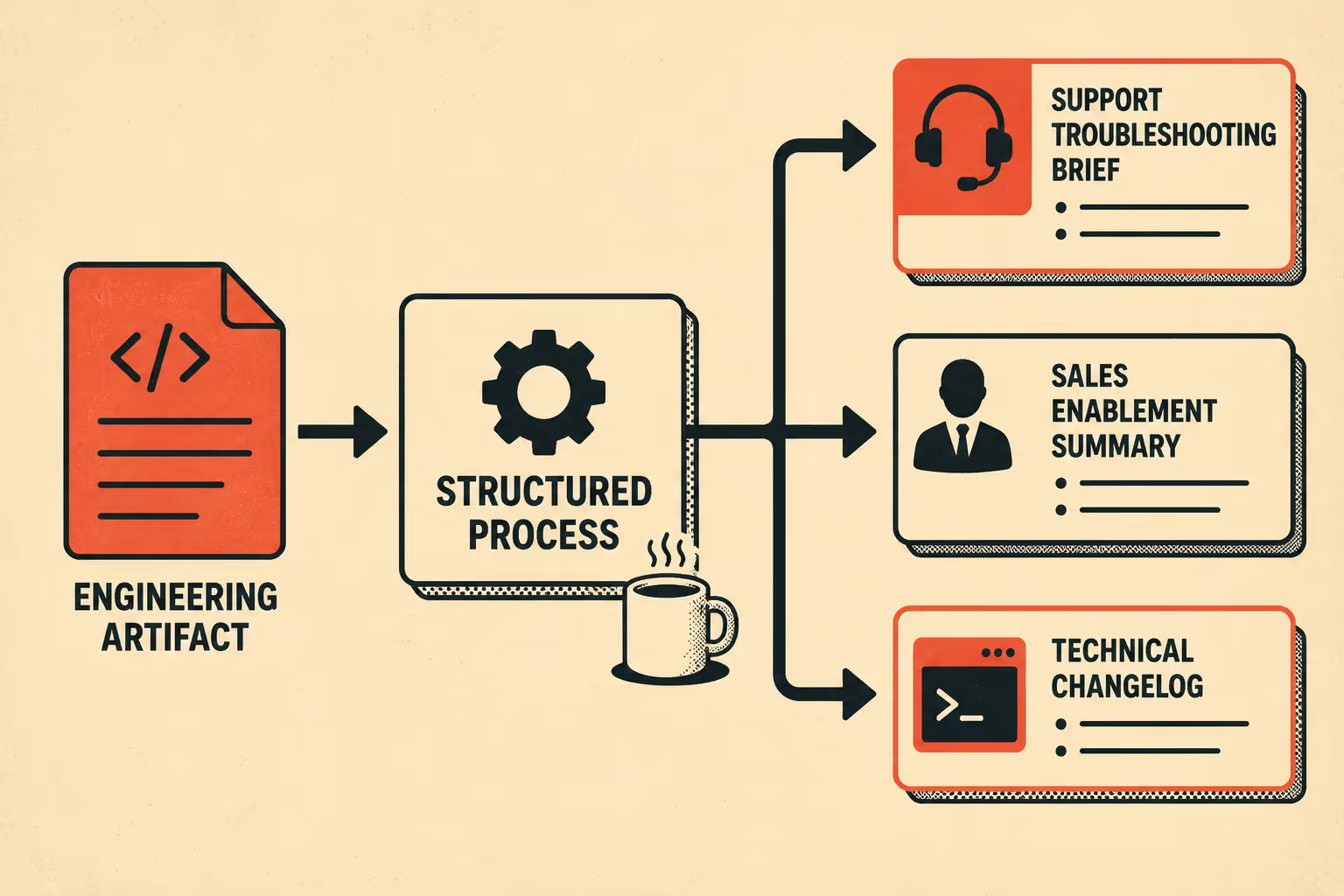
The solution isn't to ask engineers to write better customer-facing documentation. It's to build a workflow where the engineering artifact is the input, not the output.
The underlying model is straightforward: one structured source, multiple audience-specific renders. The technical changelog is one output. The support troubleshooting brief is another. The sales enablement summary is a third. Same facts, different lenses. Klepper et al. proposed a semi-automatic approach for generating audience-specific release notes integrated with continuous delivery workflows as far back as 2016. What's changed is that LLMs now make the rendering step fast enough to be practical at the velocity modern teams ship.
Mews, which moved to continuous delivery (deployment per closed issue), documented exactly this problem: with a few deployments per week, it was manageable for technical writers to monitor deployments and manually publish customer-facing release notes. At continuous delivery velocity, that manual process broke down. Their solution was to treat deployments and release notes as system entities, with the engineering workflow triggering a writing task for the technical writing team automatically. The writer still reviews and publishes. They just don't start from scratch.
That's the model worth replicating. The writer is still in the loop. They're just not the bottleneck anymore.
The Harness 2025 State of AI in Software Engineering report found that 63% of organizations are now shipping code faster since adopting AI coding tools, but only 6% describe their continuous delivery process as fully automated. The code is moving faster; the downstream communication hasn't caught up. That gap is where support gets blindsided, sales misses the update, and product loses the thread.
The validation concern is real, and it's worth addressing directly. These systems work best when a human with institutional knowledge is running them. The value isn't "no human involvement." It's human effort applied to oversight and judgment instead of transcription. A technical writer reviewing a structured draft is doing editorial work. A technical writer hunting through two weeks of PRs at 11 PM before a release is doing data entry. Those are not the same job, and only one of them is worth their time.
Strong technical writers become more valuable in this model, not less. They're managing a process that scales across multiple teams (validating output, customizing messaging by audience, flagging edge cases) rather than writing individual documents in isolation. The DORA 2024 report estimated that a 25% increase in AI adoption should produce a 7.5% increase in documentation quality, but only when that AI is paired with the kind of human governance that catches what automated generation misses.
One skilled operator, running a structured process, can keep an entire organization synchronized with what's shipping.
Doc Holiday generates release notes, changelogs, and internal summaries directly from engineering workflows, giving that operator something worth reviewing rather than something worth rewriting from scratch. The structure is already there: validate the output, customize the messaging by audience, distribute without manually translating everything from engineering language into English. That's the leverage that turns a documentation bottleneck into a documentation system.