What is Continuous Documentation?


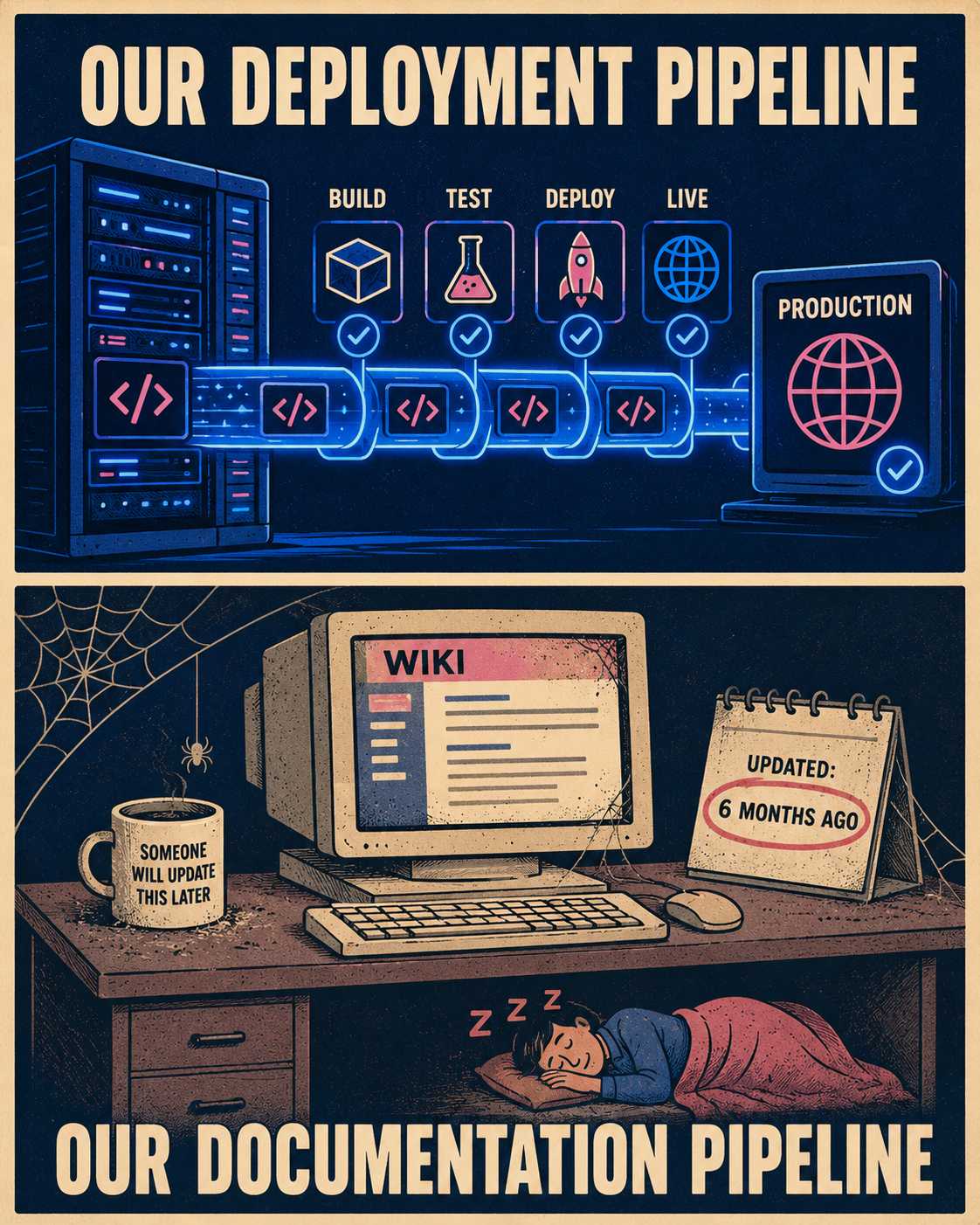
If you walk into a modern engineering organization, you will find a deployment pipeline that looks like a marvel of industrial engineering. Code is written, tested, merged, and shipped to production in minutes. The infrastructure scales automatically. The tests run in parallel. The release frequency is measured in hours, not quarters.
Then a customer asks how the new API endpoint works. Or a new engineer tries to understand the authentication flow.
And the team hands them a static wiki page that was last updated six months ago.
This is the reality of modern software development. We have automated the delivery of code, but we have left the delivery of knowledge in the manual era. Continuous documentation is the structural answer to this problem. It is the practice of treating documentation as a first-class citizen in the CI/CD pipeline (the automated system that builds, tests, and deploys software), ensuring that it updates in sync with code changes, pull requests, and deployments, rather than being batch-updated quarterly or patched retroactively after launch.
It is an operational necessity, not a philosophy.
The Speed Limit of Manual Writing
The concept emerged because the old model broke.
When release cycles were quarterly, a human writer could keep up. They could interview engineers, draft release notes, and publish a comprehensive manual alongside the software. But as engineering velocity increased and release cycles shortened, that model became a bottleneck.
Today, elite engineering teams deploy on demand, often multiple times a day. When you are shipping code that fast, manual documentation is physically impossible to maintain. By the time a writer finishes a guide for a new feature, the feature has already changed.
The result is documentation drift. The code and the documentation diverge, and the documentation becomes a liability rather than an asset. Outdated documentation misleads developers, increases onboarding time, and creates support burden that falls on teams who never knew what shipped.
This drift is expensive. Developers already spend over 17 hours a week dealing with maintenance issues like debugging and refactoring, and a significant portion of that time is wasted navigating poor or missing documentation. The Stack Overflow 2024 Developer Survey found that 61% of respondents spend more than 30 minutes a day just searching for answers to problems they encounter at work. A lot of that search time is documentation debt made visible.
Anyway. We can all now ship code faster than ever, and seem to be having trouble figuring out how to tell people what we actually shipped.
How the Infrastructure Actually Works
The shift to continuous documentation is not about writing faster. It is about changing the infrastructure of how documentation is produced.
It starts with treating docs as code. This means writing documentation in plain text formats like Markdown, storing it in the same version control repository as the source code, and subjecting it to the same review processes. When documentation lives in the same repository as the code it describes, it can be updated in the same pull request that changes the code.
But storing docs with code is only the first step. The real shift happens when you automate the ingestion of changes.
In a continuous model, the CI/CD pipeline does not just build the software; it builds the documentation. It extracts metadata from commit messages, pull requests, and code annotations. It uses static analysis to understand which functions changed, which API endpoints were modified, and which parameters were added or removed. When a developer merges a pull request that changes an API endpoint, the pipeline detects the change, generates a draft update to the API reference, and flags it for human review.
The Conventional Commits specification is one practical way to make this work. By structuring commit messages with typed prefixes (feat, fix, breaking change), teams create machine-readable metadata that can be used to populate release notes and changelogs automatically. The structure has to exist somewhere upstream of the document for the document to be generated correctly.

This is what continuous documentation looks like day to day: not a writer manually tracking every change, but a pipeline that detects changes, generates drafts, and routes them to the right people for review before they publish alongside the code.
The Part Everyone Gets Wrong
The most common misconception about continuous documentation is that it eliminates the need for human writers.
It does not.
If you wire an AI model directly to your commit history and publish the output without oversight, you will not get continuous documentation. You will get a continuous stream of drafts that are missing context, inconsistent in tone, and occasionally wrong about what the code actually does. AI models are powerful tools for generating initial drafts from code diffs, but they need human governance to maintain architectural coherence and factual accuracy across a large, evolving codebase.
The transition to a continuous model requires a shift in human roles. Writers and editors move from manually drafting every change to validating, refining, and governing automated output. They manage the system that does the drafting. The automation handles the toil: tracking down which endpoints changed, updating parameter lists, generating the first draft of a release note from a set of merged pull requests. The humans handle the context: explaining why the change matters to the user, ensuring the tone is consistent, and catching the cases where the automated output missed something important.
This also requires cultural buy-in from engineering. The automation infrastructure can only ingest what the engineers provide. If commit messages are vague and pull requests are untagged, the automated output will be useless. Good commit hygiene and structured metadata practices are the fuel that makes the system run. Teams that adopt Conventional Commits or require structured PR descriptions are not just improving their version control practices; they are building the raw material that continuous documentation needs to function.
The transition is not primarily a tooling problem. It is a workflow problem. The tooling exists. The harder part is getting engineering, product, and documentation teams to agree on the upstream practices that make the tooling useful.
The Quality Control Layer
When you elevate humans to governance roles, you create a quality control layer that makes the system scalable.
The operational model looks like this: AI generates first drafts from code commits and pull request metadata; a writer or senior engineer reviews for accuracy and consistency in a structured review workflow; edge cases are flagged and corrected; and patterns from those corrections are fed back to improve future output. The humans are not eliminated. They are elevated from drafters to editors, from editors to system managers.
This is the only way to keep documentation synchronized with high-velocity releases without rebuilding a massive documentation headcount. Research on LLM-assisted documentation generation confirms that human-in-the-loop review is what separates usable output from unreliable output: systems that achieve high answer relevancy scores do so because they are designed for human validation, not despite it.
The operational challenge is building the system that manages it. You need a structured way to generate drafts from engineering workflows, route them to the right people for review, and publish them alongside the code. A tool like Doc Holiday is built for exactly this workflow: it generates release notes, changelogs, and API references directly from engineering activity, and it provides the structure for your team to validate, manage, and scale that output without rebuilding large documentation headcount. The generation is automated. The governance is human. That combination is what makes continuous documentation an operational reality rather than just a good idea.