How to Keep Notion Documentation Synchronized With Github Activity


A developer closes a PR on a Friday afternoon. Branch merged, release cut, ticket closed. The feature is live. The Notion page still says "last updated March."
Nobody is lying. Nobody is being lazy. The documentation lives in a different workflow than the code, and the two workflows have a coordination problem that good intentions cannot fix. Developers close PRs; then someone has to remember to update Notion. That second step is a separate task competing with the next sprint, and it loses constantly.

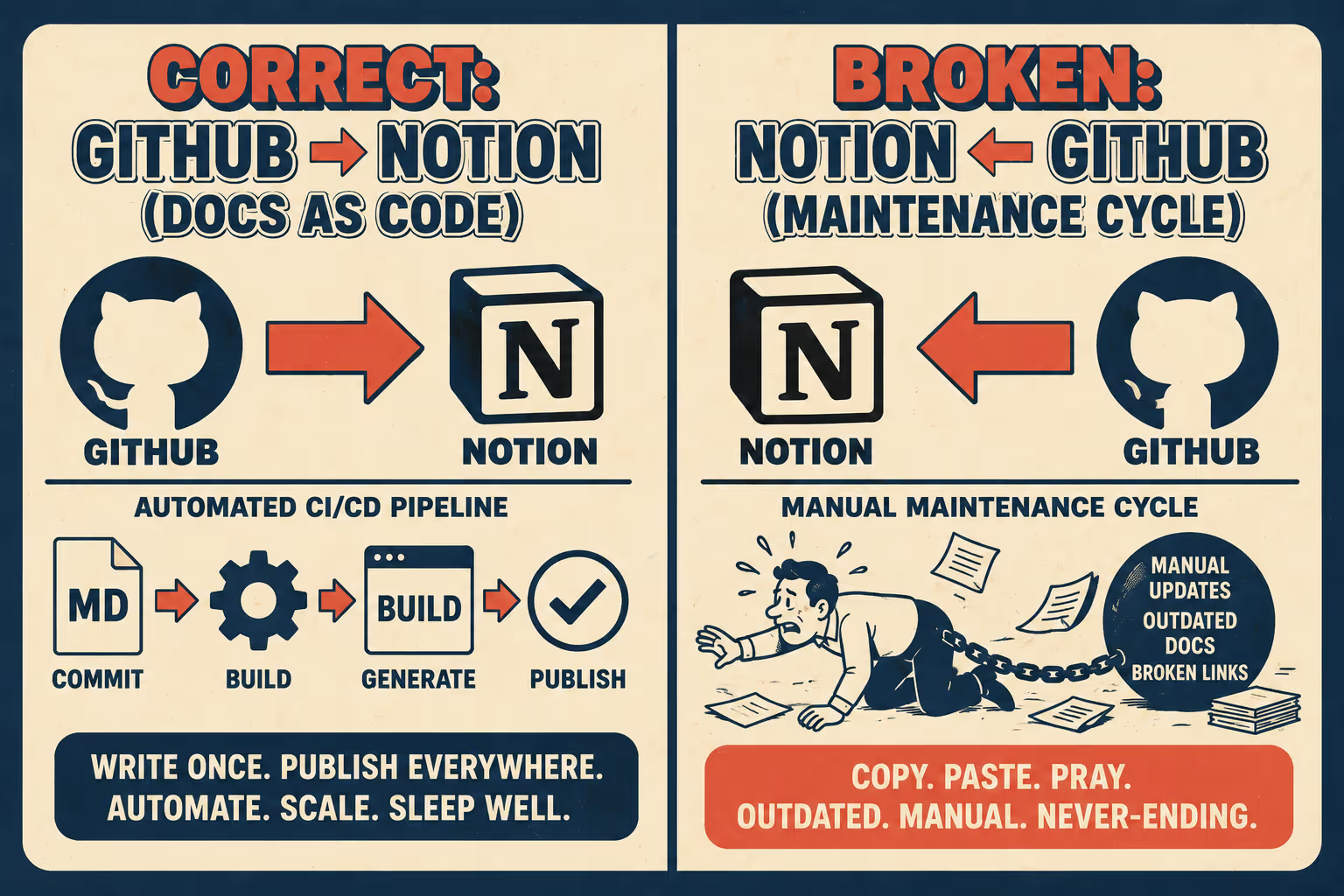
The answer is to stop treating documentation as a second workflow and start generating it from the first one. GitHub is the source of truth for engineering activity. Notion is a collaboration surface. The sync should flow from GitHub outward, not from Notion inward. How you get there depends on where your team is right now.
Why the Checklist Doesn't Hold
The first thing teams try is discipline. PR templates with a documentation checkbox. Slack reminders on release day. A shared understanding that "we update the wiki before closing the sprint."
This works, sometimes, for small teams with slow release cycles and a specific person who cares. The documentation stays reasonably current as long as that person is around, the deadlines aren't crushing, and the team hasn't grown past the point where everyone knows what everyone else is shipping.
None of those conditions are stable.
The person who remembers leaves. Priorities shift. A crunch quarter arrives and the checkbox gets unchecked. Research on software project turnover shows that when contributors leave, the knowledge they held doesn't automatically transfer, and the documentation that was supposed to capture it is often the first thing that fell behind. The wiki becomes a record of how the system worked two engineers ago.
Small teams sometimes make this tier work through sheer willpower. It doesn't survive growth.
What the Zapier Approach Actually Buys You
The second tier is automation: Zapier workflows, GitHub webhooks, custom scripts that push commit summaries into Notion pages, auto-create changelog entries when PRs merge, link releases to the relevant documentation.
This is genuinely better than nothing. You can push commit summaries to Notion automatically. You can create a new changelog entry every time a release tag is cut. You can link a merged PR to the documentation page it affects. Notion's API supports this at up to three requests per second, which is fine for light automation and starts to become a bottleneck when you're shipping frequently.
The real cost isn't the rate limit. It's the maintenance.
Someone has to own the Zap library. Scripts break when APIs change. Edge cases multiply: what happens when a PR touches three different features? What happens when a release is reverted? What happens when the commit message is "fix stuff"? The automation handles the happy path and quietly fails on everything else.
Over time, the Zap library becomes its own form of technical debt. Teams that have been through this tier usually describe it the same way: it worked until it didn't, and then nobody knew why it had stopped working.
The Direction of the Sync Matters
The third tier is where the coordination problem actually gets solved, and it requires a small but important reframe.
Notion is not a source of truth for engineering activity. GitHub is. Trying to make Notion the authoritative record of what your system does, by pushing data into it and hoping it stays current, reverses the natural direction of information flow. The code changes in GitHub. The documentation should be derived from those changes, not maintained in parallel with them.
This is the docs-as-code philosophy: treat documentation as a build artifact, generated from the same source that generates the software. When a PR merges, the CI/CD pipeline generates the release notes. When a release is cut, the changelog is produced from the commit and PR history. The output is clean, structured, and accurate because it comes directly from the activity that produced the change.
Squarespace's engineering team described this shift as making documentation "a more integrated, efficient, and enjoyable part of our development process." The key word is integrated. When documentation lives in the same workflow as the code, it gets updated when the code gets updated, because those are the same event.
The sync to Notion then becomes the last step, not the whole system. Validated documentation flows into Notion for visibility and team access. Notion stays current because it's receiving output from a process that runs automatically, not waiting for someone to remember.
Recent work on LLM-powered release note generation (Daneshyan et al., FSE 2025) shows that automated systems can produce release notes that match or outperform manually written ones on completeness, clarity, and organization, when the generation is grounded in commit, PR, and code context. The quality problem is solvable. The question is whether you have the infrastructure to run it reliably.
Where to Draw the Line
If you have fewer than 10 engineers and your release cycles are measured in weeks rather than days, manual discipline might hold. The coordination overhead is low enough that a checklist and a person who cares can keep things reasonably current.
If you're scaling, or shipping daily, or have experienced the moment where the person who maintained the wiki left and nobody noticed for two months, you need automation that runs as part of the build process. A side workflow that someone has to remember is not automation; it's a reminder that will eventually get ignored.
Poor documentation costs engineering teams up to $2M annually when you add up lost productivity, slower onboarding, and the compounding cost of decisions made on stale information. That number is almost entirely a coordination failure, not a writing failure. The writing is fine. The problem is that the writing happens in the wrong place, at the wrong time, by the wrong person.
Doc Holiday generates release notes, changelogs, and API references directly from GitHub activity, with a structured review path so a technical writer or support lead can manage output quality without recreating the content from scratch. The validated output syncs to wherever your team works, including Notion. The documentation stays current because it's produced by the same process that produces the software, not by a second process that has to keep up with the first one.