How to Write Release Notes in Plain English


Your engineering team just spent three months building a feature that solves a real customer problem. They shipped it on time. The product marketing team drafted the positioning. The changelog was updated, the product update email was sent, and the sales team was briefed.
Three weeks later, adoption is sitting at single digits.
The sales team can't pitch the feature because they don't understand what it actually does. The support organization is fielding tickets about the exact thing that was supposedly fixed. Customer success has no idea how to tie the update to the pain point the client mentioned on their last call.
The release notes exist. They are technically accurate. They are comprehensive. And they are completely useless to anyone outside of engineering.
This is the reality for most software companies. The notes are written for engineers, by engineers. They document what changed in the codebase, not what changed for the user. And when non-technical stakeholders need to act on them, the communication breaks down.
Anyway. We have a translation problem.
The Translation Tax
The cost of poor documentation isn't just a few confused salespeople. It is a measurable drag on the organization. Research analyzing 32,425 release notes across 1,000 GitHub projects found significant discrepancies between what release note producers think is important and what users actually need. The gap is structural, not accidental.
Someone has to translate the engineering output into business value. Usually, this falls on a product manager or a technical writer who is already under-resourced. They end up writing two versions of everything: one for the developers, and one for everyone else.
This doesn't scale. But the alternative, publishing notes no one outside engineering can parse, has a real cost in misalignment, duplicated questions, and missed opportunities.
There is a better way to structure this information so that it serves both audiences without requiring two separate documents.
Lead With the Outcome, Not the Implementation
Non-technical readers need to know what changed for the user and why it matters before they care how it works under the hood.
Start every release note with a single sentence that answers a basic question: what can someone now do that they couldn't do before, or what problem does this fix?
The contrast is immediate once you see it side by side.
The pattern is consistent. The engineer-speak version describes what changed in the system. The plain English version describes what changes for the person using it. One is a commit message. The other is a release note.
State the impact first. Then layer in the technical detail for the readers who actually need it.
Interaction designers have a concept called progressive disclosure: initially, show users only the most important options, and offer a larger set of specialized options upon request. The same logic applies to documentation. The very fact that something appears at the top of a note tells readers it is important. Everything else is detail, and detail can wait.
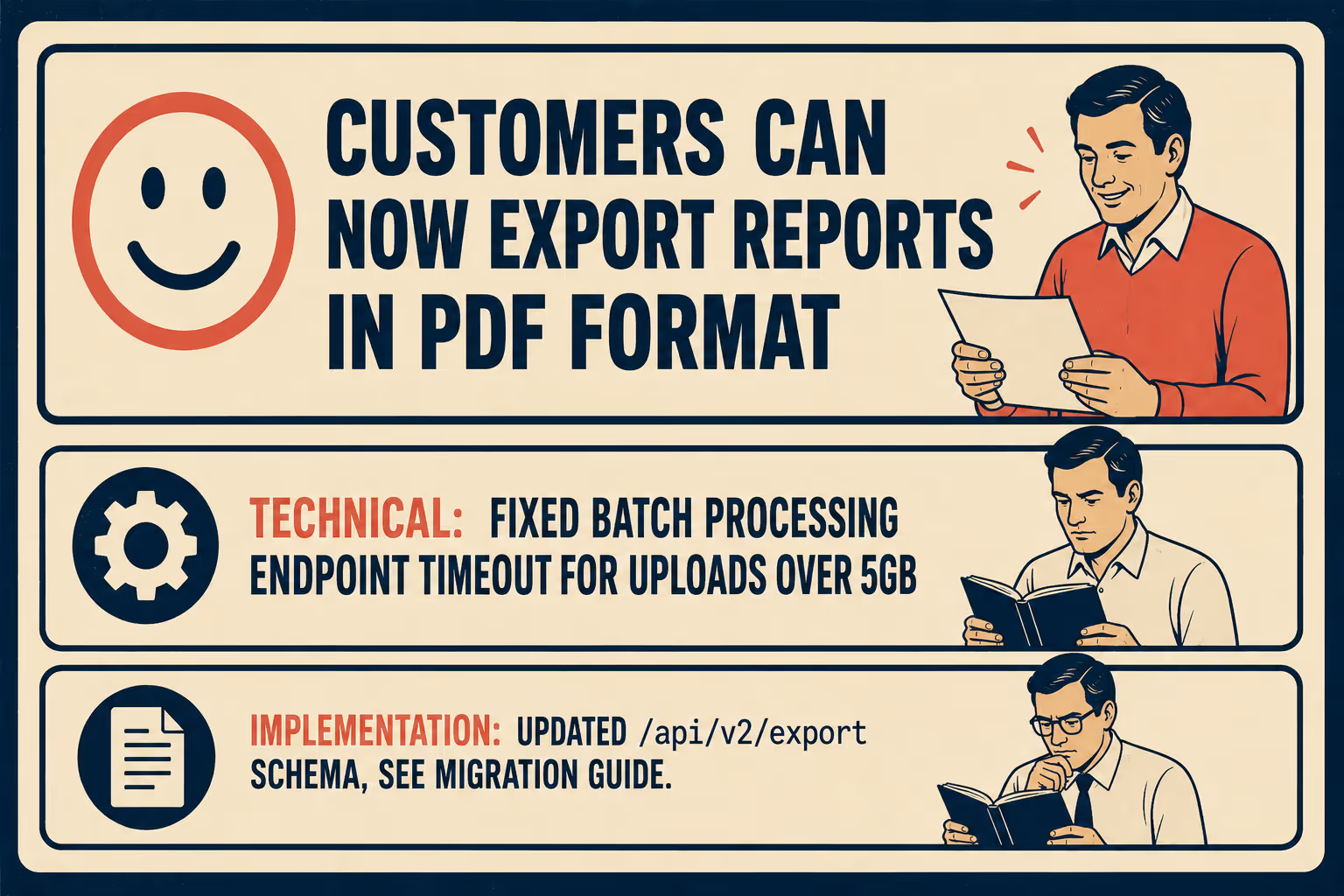
The structure that follows from this is straightforward. The first sentence or two is the customer-facing summary: the outcome-driven statement that answers what changed and why it matters. Below that, a clearly marked technical explanation covers the mechanics for support agents and technical PMs who need to understand the fix. Below that, implementation details handle API changes, schema updates, and code-level specifics for the developers who need them.
The sales rep reads the first sentence and moves on. The support agent reads the first two sections. The developer reads the whole thing to update their integration.
One document. One source of truth. No translation required.
Why asking engineers to fix this usually doesn't work
Knowing how to structure a good release note doesn't solve the operational problem of actually writing them.
Many developers view writing release notes as a tedious and dreadful task. They want to write code, not documentation. And when they do write documentation, they write it for themselves. In fast-paced development environments, documentation gets deprioritized due to tight deadlines and a focus on delivering working code. The result is informal, hard-to-understand notes that quickly become outdated as the software evolves.
The problem is cognitive, not disciplinary. The curse of knowledge is a well-documented phenomenon in which experts find it genuinely difficult to reconstruct what it felt like not to know something. Developers who built a feature understand it at a level of abstraction that makes the user-facing impact feel obvious to them. It isn't obvious to anyone else. The curse of knowledge occurs when an author assumes their audience has prior knowledge to understand their writing fully, and it is particularly acute when the author is also the engineer who built the thing being documented.
Asking engineers to translate their own work into plain English is asking them to perform a task that runs against the grain of how they think about what they built. Some engineers are great at this. Most are not, and the ones who are not don't know they're not.
The solution is a review layer: someone who understands both the technical change and the customer's mental model, and whose job is to validate the translation before it ships. This is what a good technical writer or product manager does. They are not rewriting the note from scratch. They are checking whether the outcome statement actually describes what the customer experiences, whether the jargon in the technical section is scoped to the audience that needs it, and whether there is a "so what" that tells the customer what to do differently now.
The Google Developer Documentation Style Guide and the U.S. National Archives plain language principles both converge on the same core rules: write for your reader, state the major point first, use active voice, and use everyday words. These are not writing tips. They are decision rules. Applied to release notes, they translate into a specific checklist for the review layer:
- Does the first sentence describe a user outcome, not a system change?
- Is the subject of the sentence the user or the product, not the code?
- Is there a clear instruction for what the user should do differently now, if one is needed?
- Are technical terms scoped to the section that technical readers will actually read?
The review layer doesn't need to be a full editorial pass on every note. It needs to be a consistent gate that catches the notes where the translation didn't land.
The operational reality of doing this at scale
A review layer is necessary. It is also a bottleneck if it is the only mechanism you have.
Organizations that ship frequently, multiple releases per sprint, can't rely on manual rewriting for every update. The Stack Overflow 2024 Developer Survey found that the two areas where developers felt they would get the most value out of AI tools were code testing and documentation. The reason is obvious: both are important, both are tedious, and both are well-defined enough that a system can do a reasonable first pass.
The current generation of documentation tools can generate release notes directly from engineering artifacts: commit messages, pull requests, and issue titles. The challenge that existing tools have struggled with is audience personalization. A tool that generates a single undifferentiated output has the same problem as the engineer writing the note manually: it optimizes for one reader.
The right model is generation plus validation. AI drafts the customer-facing summary and the technical detail as separate layers. A product manager or technical writer reviews the output, adjusts where the framing missed, and approves it. The human doesn't rewrite from scratch; they ensure the translation landed correctly. This is what makes the approach scalable without sacrificing accuracy.
Doc Holiday is built around this workflow. It generates release notes directly from engineering workflows, with user-facing summaries and technical detail separated by default, and provides a structured review layer so the right person can validate the output before it ships. The structure is defined once. The generation is consistent. The human oversight is the quality check, not the bottleneck.
The result is release notes that work for every reader without requiring separate documents or doubling the workload. Non-technical stakeholders get clarity, technical stakeholders get precision, and no one has to maintain two versions of the truth.