How to Write Patch Notes That Build Customer Trust


If you ran a SaaS company and your engineering team shipped an update that fixed three critical bugs and cut dashboard load times by 70%, you would have two options for how to tell your customers.
Option one: "We've made some under-the-hood improvements to make your experience faster and more reliable."
Option two: "We fixed the memory leak that was causing the analytics dashboard to crash when exporting reports with more than 10,000 rows. We also rewrote the database queries for the main dashboard, reducing load times from 4.2s to 1.1s for workspaces with 500+ projects."
Option one is marketing copy. Option two is a trust signal.
Patch notes are a surprisingly high-leverage trust signal. When done well, they tell customers you're listening, fixing the right things, and treating their time with respect. When done poorly (vague, inconsistent, or missing entirely) they erode confidence even when the underlying engineering work is solid. Trust comes from accuracy, not spin.
A 2019 survey by technical writer James Scott found that 83.6% of users actually read release notes or app updates, and a third of them read them regularly. The top reason people gave for reading them: they want to know what's new or changed. They are paying attention. The question is whether you're giving them something worth reading.
The Thing Vague Language Actually Signals
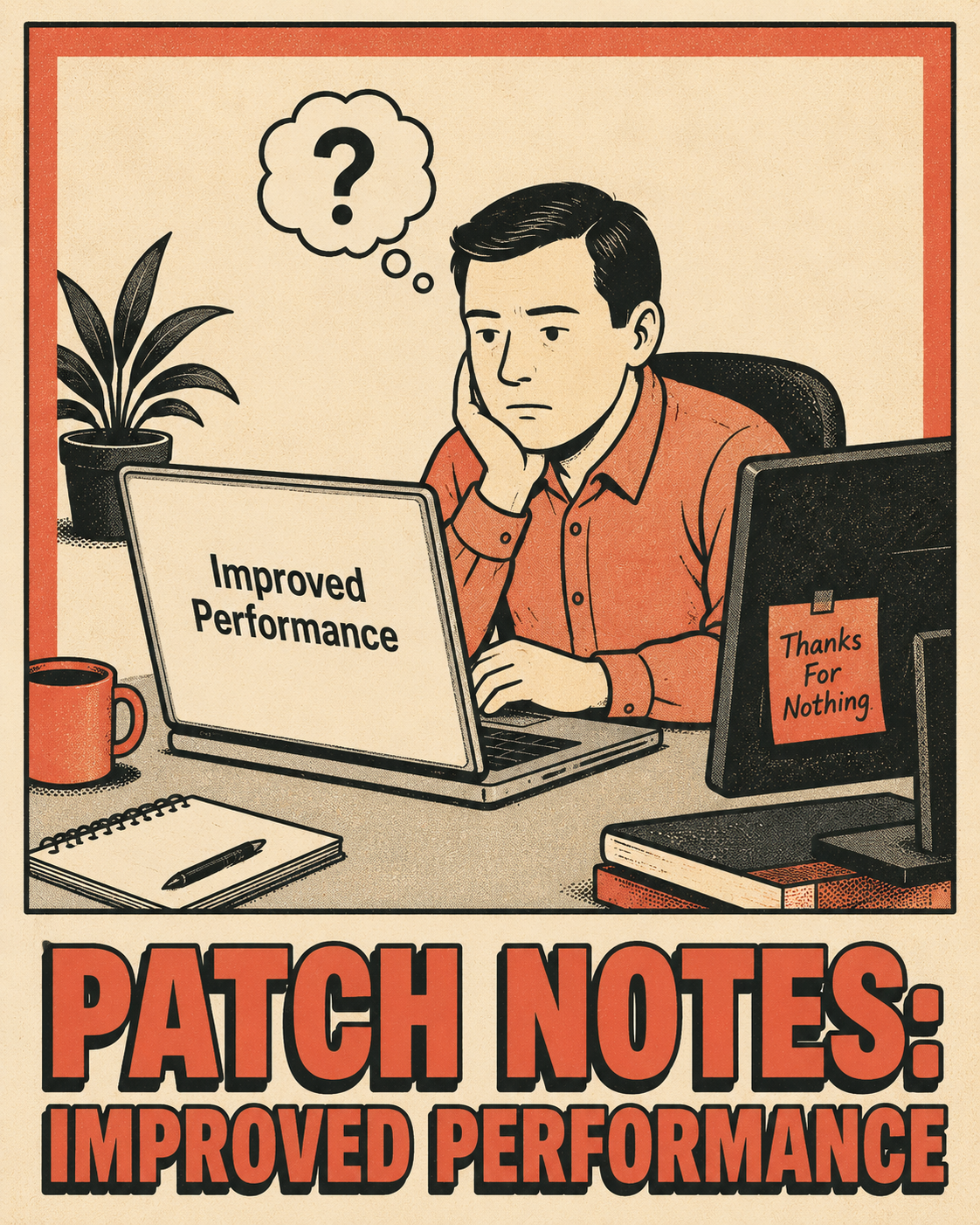
"Improved performance" is not just useless. It's actively counterproductive.
When a customer reads "improved performance," they have no way to know whether the improvement is relevant to them. They can't tell if it addresses the slowness they've been experiencing, or if it's a different part of the product entirely. They can't tell if it's a 5% improvement or a 70% improvement. They can't tell if it required a significant engineering effort or if someone tweaked a config value.
What they can tell is that you didn't think it was worth explaining.
Deloitte's 2022 research on customer trust in the technology sector found that fewer than 40% of B2B technology customers highly trusted the brand from which they recently purchased. The four factors of trust they measured: capability, reliability, transparency, and humanity. Transparency was the one most directly in the product team's control, and the one most commonly neglected.
Translating engineering-speak into user impact without losing precision is the core skill here. It requires understanding both the technical implementation and the customer's workflow. "We migrated our caching layer to Redis" means nothing to most users. "Reports that previously took 30+ seconds to load now load in under 3 seconds" means everything.
The formula is simple: name the change, name who it affects, and name the before-and-after. Keep a Changelog, the widely-adopted open-source standard for changelog formatting, puts it plainly: "Changelogs are for humans, not machines." The engineering commit log is for machines. The patch note is for the person who spent 45 minutes on a support call last week because your product was slow.
Anyway. The specificity problem is solvable. The harder problem is what to do when something breaks.
When You Broke Something and Everyone Knows It
Patch notes that only celebrate wins feel like propaganda.
If a bug affected real workflows, name it plainly and explain the fix. Users who filed tickets want confirmation you heard them. Users who didn't file tickets but experienced the problem want to know it's been addressed. Users who never encountered the bug want to know you have the kind of culture that acknowledges mistakes.
This is where many teams hesitate. They worry that admitting a bug in the release notes is an admission of liability, or that it will draw attention to a problem customers might not have noticed. Both concerns are usually wrong.
A comprehensive 2024 analysis of software release notes challenges on GitHub found that the most common complaint practitioners had about release notes was not that they were too candid, but that they were too incomplete. Users who encounter a bug and then see it silently disappear without acknowledgment don't conclude that the team is competent and discreet. They conclude that the team doesn't communicate.
The practical standard here is: if a bug had a ticket number, it deserves a line in the release notes. If it affected a named workflow, name the workflow. If it was reported by a customer, that customer should be able to read the release notes and recognize their problem.
Stripe's public changelog is a useful reference point. Each entry is specific, functional, and written from the user's perspective. When something changes that affects existing integrations, they say so directly. There's no spin. The notes read like they were written by someone who respects the reader's time.
Acknowledging what broke is not a confession of incompetence. It's a demonstration of accountability. The teams that do it consistently build a different kind of credibility than the teams that don't.
The Part No One Has a Process For
Here is the real problem: most organizations don't have a consistent process for writing patch notes at all.
An empirical study of release note production and usage in practice, which analyzed 32,425 release notes across 1,000 GitHub projects, found that the quality and completeness of release notes varied enormously, and that the variation was largely a function of process, not intent. Teams that had a structured approach produced consistent notes. Teams that didn't produced whatever the engineer who shipped the code felt like writing at 11pm before a release.
A separate arXiv study on automated release note generation found that 37% of releases in their dataset had empty release notes entirely. Not vague notes. Empty ones. Nothing.
The fix is a lightweight review layer, not a bureaucratic one. Three questions are enough:
- Does this entry name the user impact, not just the technical change?
- If a bug was fixed, does the entry acknowledge what broke and for whom?
- Is there anything that shipped in this release that isn't mentioned?
The third question is the most important and the most commonly skipped. Coverage gaps are where trust erodes quietly. A customer who experienced a bug and doesn't see it in the release notes doesn't know whether it was fixed. A customer who reads about a new feature they didn't know existed doesn't know whether they're already using it. Incomplete notes create uncertainty, and uncertainty is the enemy of trust.
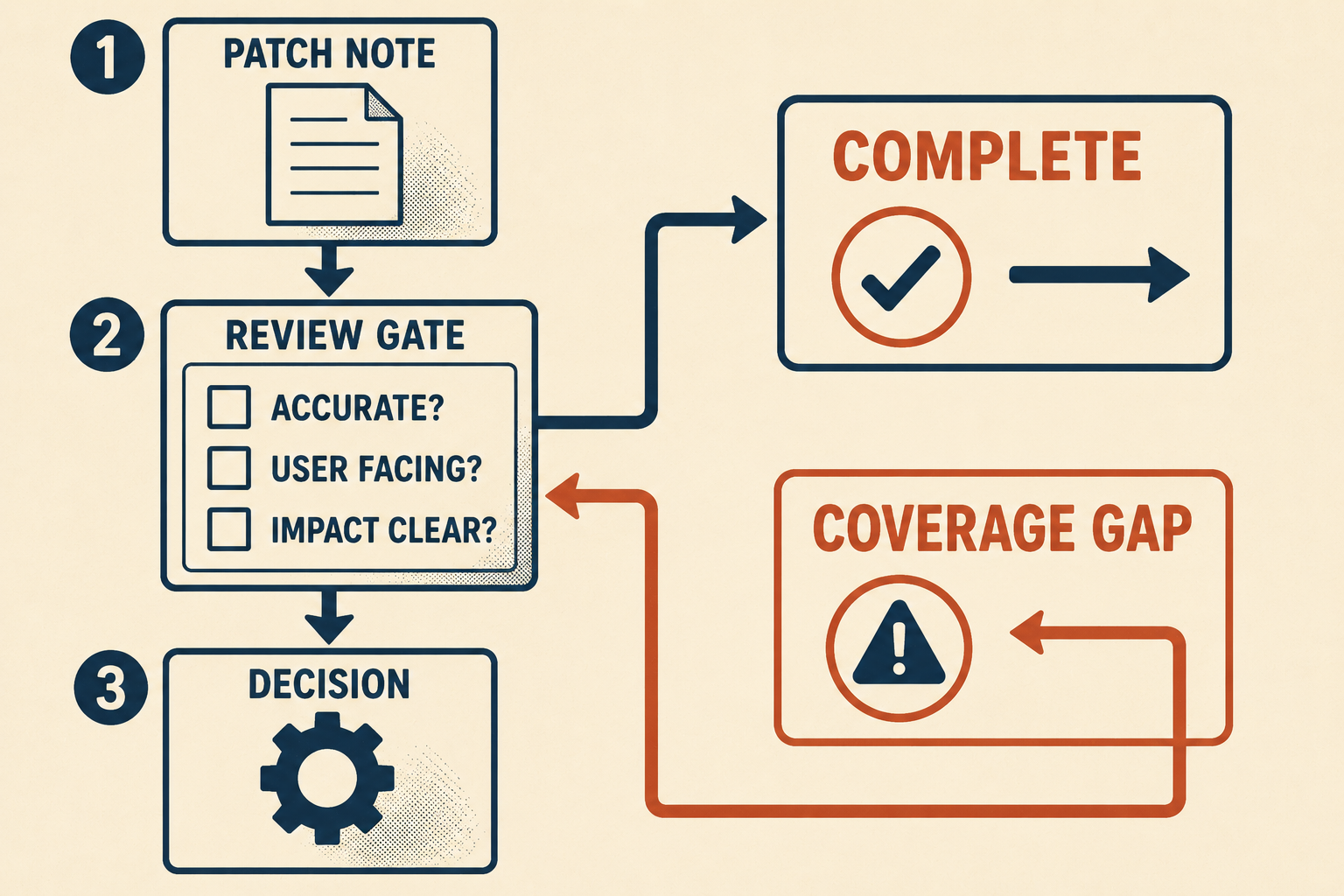
Who runs this review? In most teams, it should be a technical writer or a product ops person with enough context to catch user impact framing failures. The review doesn't need to be long. It needs to happen before the notes go out, not after.
A 2023 IEEE study characterizing the structure, writing style, and content of GitHub release notes found that the most effective release notes were those that combined technical precision with user-facing framing, not one or the other. The engineering detail gives the note credibility. The user-facing framing makes it useful. Both are required.
The teams that get this right treat patch notes as a product feature. They integrate the writing process into the engineering workflow. They don't write the notes after the release; they write them as part of it. Linear's changelog is a good example of what this looks like at scale: every entry is categorized, every fix is described in terms of what was wrong and what changed, and the notes are published on a consistent cadence. It reads like a team that takes its own communication seriously.
The trust-building piece still requires a human who understands what matters to customers and can validate that the output reflects real priorities. Patch notes that pull directly from engineering workflows solve the consistency and coverage problem: nothing ships without an entry, and the structure is standardized from the start. Doc Holiday generates those first drafts automatically from code commits, so your technical writers and product ops team can focus their time on the framing and tone that actually build trust, rather than chasing down engineers to find out what shipped.
That's the leverage. The engineering work is already done. The question is whether the communication around it is doing its job.