How Better Documentation Actually Reduces Support Ticket Volume


Say you run support for a SaaS product. You pull the monthly ticket report, and you notice something uncomfortable: the top fifteen recurring issues all have documentation articles. The articles are findable. They're reasonably accurate. Some of them even rank in Google.
And yet the tickets keep coming.
This is the part where most teams conclude they need more documentation. More articles, more coverage, more completeness. But coverage isn't the problem. The articles exist. The problem is that the documentation was written to explain the product, not to intercept the specific confusion that generates tickets. Those are different jobs, and most documentation programs are only doing one of them.
The teams that actually reduce ticket volume treat documentation as a system driven by user behavior, not a library organized by feature. Three operational shifts separate the ones that move metrics from the ones that don't.
The Tickets Are Telling You Something
Every support ticket is a user reporting a gap in the documentation. Not always a missing article, sometimes a wrong title, a buried answer, or a step that made sense to the person who wrote it but not to the person who needed it at 11 p.m. on a Tuesday.
The most effective documentation strategies start in the support inbox, not in a feature spec.
The mechanics are straightforward. Add a tag to your helpdesk (something like "content gap") that agents apply when a ticket could have been resolved by better documentation. Run that report monthly. You'll quickly see clusters: the same three questions about the same two features, submitted by users who clearly tried to find the answer and couldn't. Those clusters are your documentation roadmap.
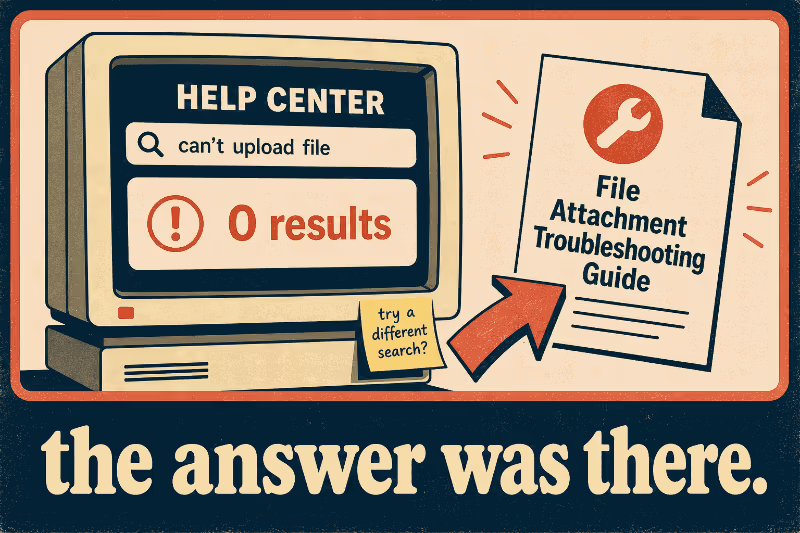
Search query analysis from your help center adds another layer. The searches that return no results, or that result in an immediate bounce, are direct signals of where content is missing or misnamed. If users are searching "can't upload file" and your article is titled "File Attachment Troubleshooting Guide," you have a discoverability problem, not a coverage problem. Gartner's research found that in 43% of self-service failures, customers simply couldn't find content relevant to their issue. The content existed. They just couldn't reach it.
Session replay tools (FullStory, Hotjar, and similar) add a third signal: they show you where users abandon flows before submitting a ticket. That abandonment point is often where the documentation should be, and isn't.
The goal is to make documentation a direct response to demonstrated confusion, not a guess about what users might need.
Nobody Reads Docs the Way You Wrote Them
Eyetracking research from Nielsen Norman Group has shown for years that users scan web pages in an F-shaped pattern. They read the first line, skim the left edge of the content, and stop when they find something that looks like their answer. They do not read introductions. They do not read feature overviews. They are not exploring.
This matters because most documentation is written for someone who is curious about the product. The user who submits a ticket is not curious. They're stuck. They arrived mid-crisis with a specific blocker, and they need the answer in the first two sentences or they're going to close the tab and open a ticket instead.
The fix is structural. Lead with the answer, not the context. If the article is about why a file upload fails, the first sentence should say when it fails and what to do about it. The background explanation can come after. Most documentation buries the answer three paragraphs in, after explaining what the feature is and why it exists. That's the wrong order for a user who already knows what the feature is and just needs it to work.
Contextual delivery matters too. The most effective documentation shows up where the user is stuck, not in a separate help center they have to navigate to. Inline tooltips, in-app walkthroughs, and contextual help panels reduce the friction of getting from "I'm confused" to "I have the answer." The fewer steps between the problem and the resolution, the higher the self-service rate.
81% of customers attempt to resolve issues on their own before contacting support. The question is whether the documentation they find is structured to actually help them, or just to exist.
The Docs You Published in Q3 Are Already Wrong
Documentation drift is the quiet killer of self-service rates. A user follows the steps in an article, the steps don't match the current UI, and they open a ticket. They're also now less likely to trust the documentation next time. The ticket volume from outdated docs compounds because it erodes the habit of self-service.
The root cause is almost always the same: documentation lives in a completely separate workflow from the changes being made. The product team ships a feature update. The engineering team modifies a workflow. The documentation is supposed to get updated too, but there's no trigger, no owner, and no deadline. Glitter AI's analysis of documentation drift found that when everyone is nominally responsible for keeping docs current, nobody actually is.
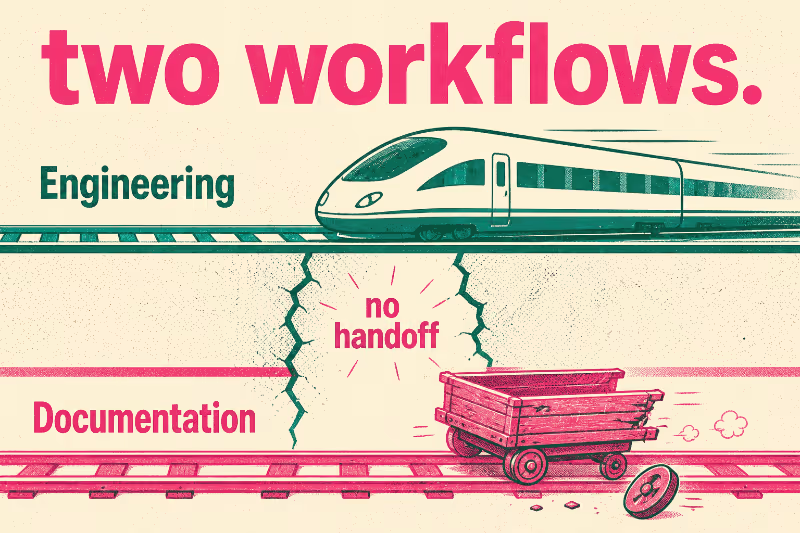
The operational fix requires two things. First, documentation updates need to be part of the definition of done. A feature isn't shipped until the relevant articles are updated. This sounds obvious and is almost never practiced. Second, every piece of documentation needs a named owner, not a team but a person, who is accountable for keeping it current when the product changes.
Version control for documentation, deprecation notices, and "this changed recently" flags help users know whether they're looking at current information. These are small additions that significantly reduce the trust deficit that comes from stale docs.
Automated release notes generated from engineering workflows (Git commits, CI/CD pipelines) close another gap. When the documentation system is connected to the change process rather than downstream from it, drift becomes structurally harder to accumulate.
Anyway. Here's what the metrics look like when this is working.
What Good Looks Like
The primary metric is topic-specific ticket volume: the number of tickets submitted about a specific issue before and after publishing or updating an article. A meaningful drop (30% or more) within 30 days is a signal that the documentation is doing its job.
Self-service resolution rate is the longer-term measure. Gartner found that only 14% of customer service issues are fully resolved in self-service, even though 73% of customers attempt it. That gap between attempt and resolution is the documentation opportunity. Teams that close it meaningfully typically see movement within 60 to 90 days of deploying better-structured, ticket-informed content.
Cost per ticket provides the ROI frame. Industry benchmarks put SaaS support tickets at $18 to $35 each. A 20% reduction in ticket volume on a team handling 500 tickets a month is $1,800 to $3,500 per month in direct cost savings, before accounting for the compounding effect of repeat contact rates. Improving first-contact resolution from 55% to 70% eliminates 25 to 30% of repeat contact volume, which is often the highest-leverage cost reduction available.
The teams that don't see movement are usually the ones that published new articles without changing how those articles are structured, titled, or delivered. Coverage without discoverability doesn't deflect tickets. It just adds to the library.
High-quality, ticket-deflecting documentation requires either significant headcount or infrastructure that automates the grunt work while preserving quality. For teams that have already reduced documentation staff or never had robust coverage, Doc Holiday generates the foundational material, release notes, API references, feature documentation, directly from engineering workflows, then provides the structure for validation and continuous updates. The alternative is choosing between incomplete coverage or ticket volume that keeps climbing.