How to Automatically Update Confluence Documentation When a Github PR Merges


Someone on the support team files a ticket. The feature they're describing was refactored three sprints ago. The Confluence page still shows the old behavior. The engineer who wrote the original page left the company.
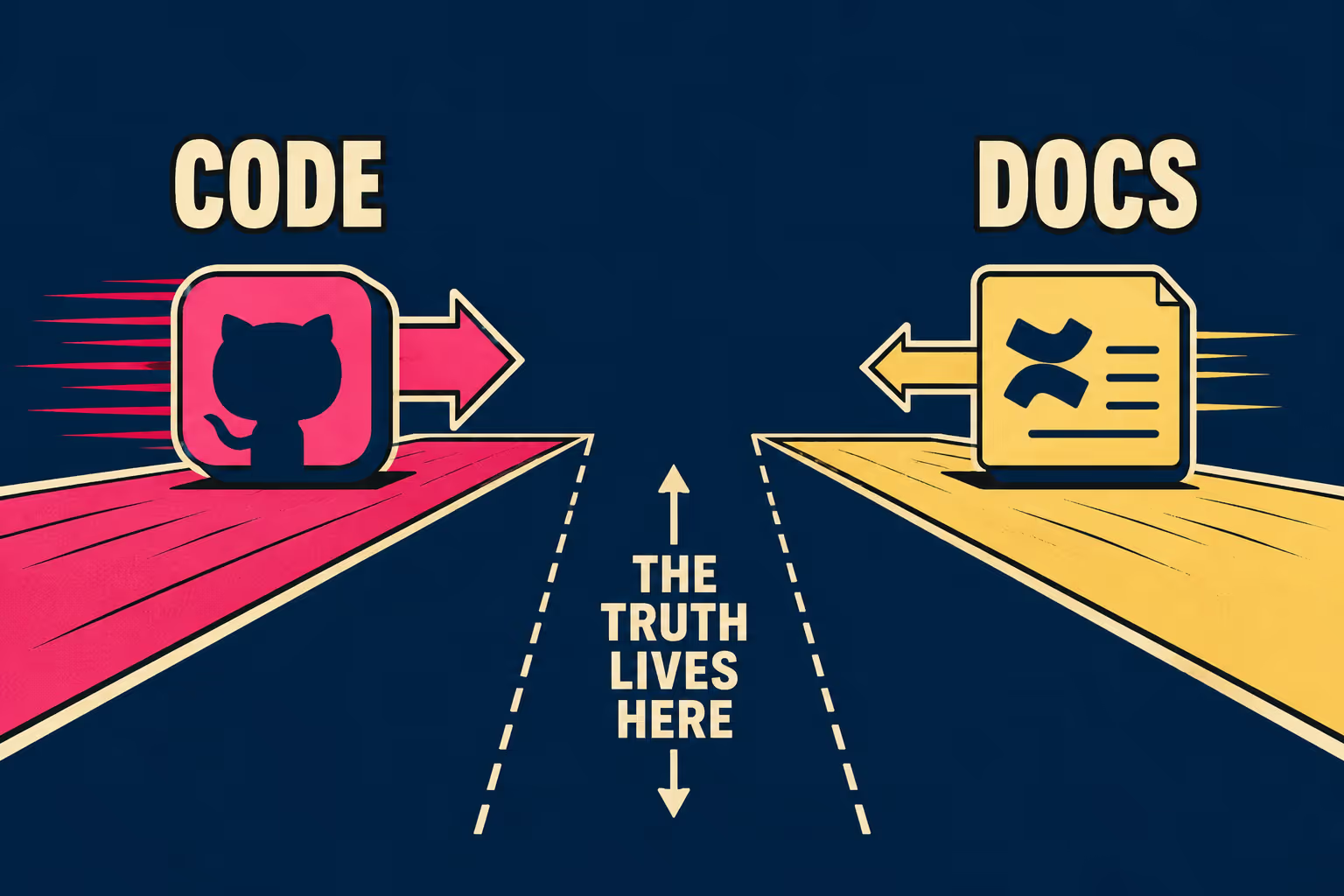
This is not a rare edge case. It is the default state of most engineering organizations that ship through GitHub but document in Confluence. The two systems are not connected. Code moves fast. Documentation does not. The gap compounds.
If you've already decided this is worth fixing, here are the three realistic paths, in order of complexity.
The Direct API Approach
The Confluence REST API v2 lets you update any page programmatically. GitHub Actions lets you run code when a pull request merges. Connecting them is about 40 lines of YAML and a Python script.
The workflow trigger is straightforward: listen for the pull_request event with the closed activity type, then check whether github.event.pull_request.merged is true before running the documentation step. GitHub's events documentation covers the specifics.
The harder part is what happens inside the script. A few things that catch teams by surprise:
Confluence uses an XHTML-based storage format, not markdown. If you're pulling text from a PR description and pushing it to a page, you need to convert it first, or wrap it in a <p> tag at minimum.
Every page update requires the current version number, incremented by one. That means a GET request before the PUT. If you skip this step, the API returns a 409 conflict. If two workflows run simultaneously on the same page, one of them will fail.
The biggest practical trap is overwriting. If you replace the entire page body with the PR description, you erase whatever a product manager or technical writer added manually. A working implementation typically fetches the existing content, finds a specific section (a table, a labeled block, a heading), appends or replaces only that section, and then writes the whole thing back. This is more code than it looks, and it breaks when someone restructures the page.
Authentication is handled through an API token tied to a Confluence account, stored as a GitHub Actions secret. The official API docs cover the auth headers.
This approach works. Teams with one or two repositories, a clear page structure, and someone who enjoys maintaining YAML files can run this indefinitely. The problem is the bus factor. A large-scale empirical study of GitHub Actions workflows across nearly 200 mature projects found that workflow files generate significant extra maintenance work, with bug fixing and CI/CD improvements being the major drivers. The researchers called it "the hidden costs of automation." When the person who built the workflow leaves, the team inherits something fragile.
The Integration Layer
When the custom script becomes too brittle, teams reach for Zapier, Make, or n8n. These platforms let you configure a GitHub webhook trigger and route the PR payload to a Confluence "update page" action through a visual interface. No YAML. No version increment logic to maintain. The platform handles authentication and retry logic.
This is a real improvement in maintainability. The workflow is visible to non-engineers. It does not live in a .github/workflows directory that only two people know exists.
The limitation is that these tools are data pipes. They move whatever text is in the PR description into Confluence without understanding it. If the PR description says "fix edge case in auth flow," that is what gets written to the page. The automation faithfully reproduces whatever input it receives.
This matters more than it sounds. Research on what practitioners expect from release notes found that the most useful documentation draws on issues (about 29% of content), pull requests (about 32%), and commits (about 19%). An iPaaS tool can route a PR description. It cannot synthesize across all three sources and produce a coherent explanation of what changed and why.
The content generation problem is different from the routing problem. If your engineers write detailed PR descriptions, Tier 2 is fine. If they don't, Tier 2 just automates the delivery of incomplete information.
When the Content Is the Problem
There is a third framing that most teams arrive at eventually: the bottleneck is not the sync, it's the authoring.
Someone still has to write the documentation. If the PR description is thin, the Confluence page will be thin. If the engineer who built the feature is the only person who understands it, and they are already on the next sprint, the documentation never gets written at all. Documentation tasks consume roughly 11% of developers' work hours, and that number assumes the documentation is actually getting done.
The approach that addresses this is treating GitHub as a data source rather than a message queue. A GitHub repository contains the commit history, the PR descriptions, the linked issues, the review comments, the code diffs, and the labels. That is a lot of signal. The question is whether you can turn it into prose.
Recent research suggests you can. A 2025 study from Peking University built an LLM-powered release note generator called SmartNote that aggregates code, commit, and PR details to produce structured, narrative notes. It outperformed traditional tools on completeness, clarity, and organization. A benchmark study analyzing nearly 95,000 release notes found that LLMs consistently outperform traditional baselines, particularly when they have access to structured commit tree information rather than just raw diffs.
The practical version of this looks like: the system reads the merged PR, the linked issue, the commit messages, and the diff, then produces a draft that a technical lead can review. Not a list of PR titles. A draft. Something that explains what changed, why it changed, and what it means for users.
A case study at a large European bank found that when engineers edited and approved AI-generated changelogs, the system learned from those edits over time. The human role shifted from assembling information to reviewing a draft. That is a different job, and a faster one.
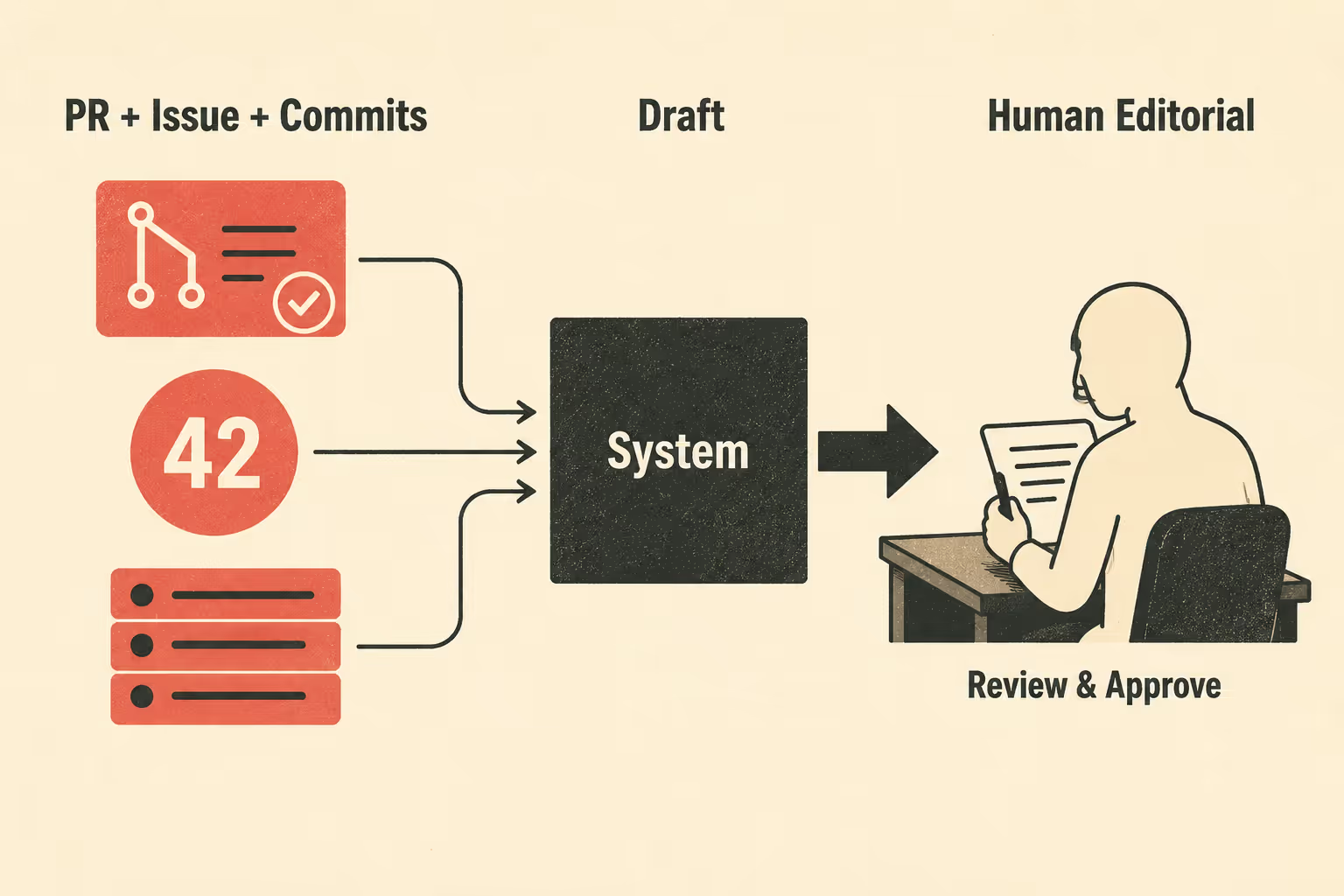
The Mercari engineering team's experience is worth reading here. Their conclusion: using AI does not eliminate the need to know what you want and why you want it, but it does eliminate the blank page. A technical lead reading a draft and approving it is doing editorial work. A technical lead hunting through two weeks of PRs before a release is doing data entry.
Which Tier Is Right
A rough framework:
The decision point is usually not repo count. It is whether the content generation problem is more urgent than the routing problem. If your
pages are outdated because no one has time to write them, adding a faster pipe does not help.
Anyway. The pattern that works at scale is the one where the system produces a first draft from the engineering artifacts that already exist, and a human validates it before it publishes. That is what Doc Holiday generates: release notes, changelogs, and documentation formatted for Confluence publication, built directly from commits and PR history, with a structured review workflow so the editorial judgment stays where it belongs.